
BLOG

How to Choose a Long-Term Logistics Partner for Your Factory? 7 Key Factors for B2B Logistics
Aug 26, 2026
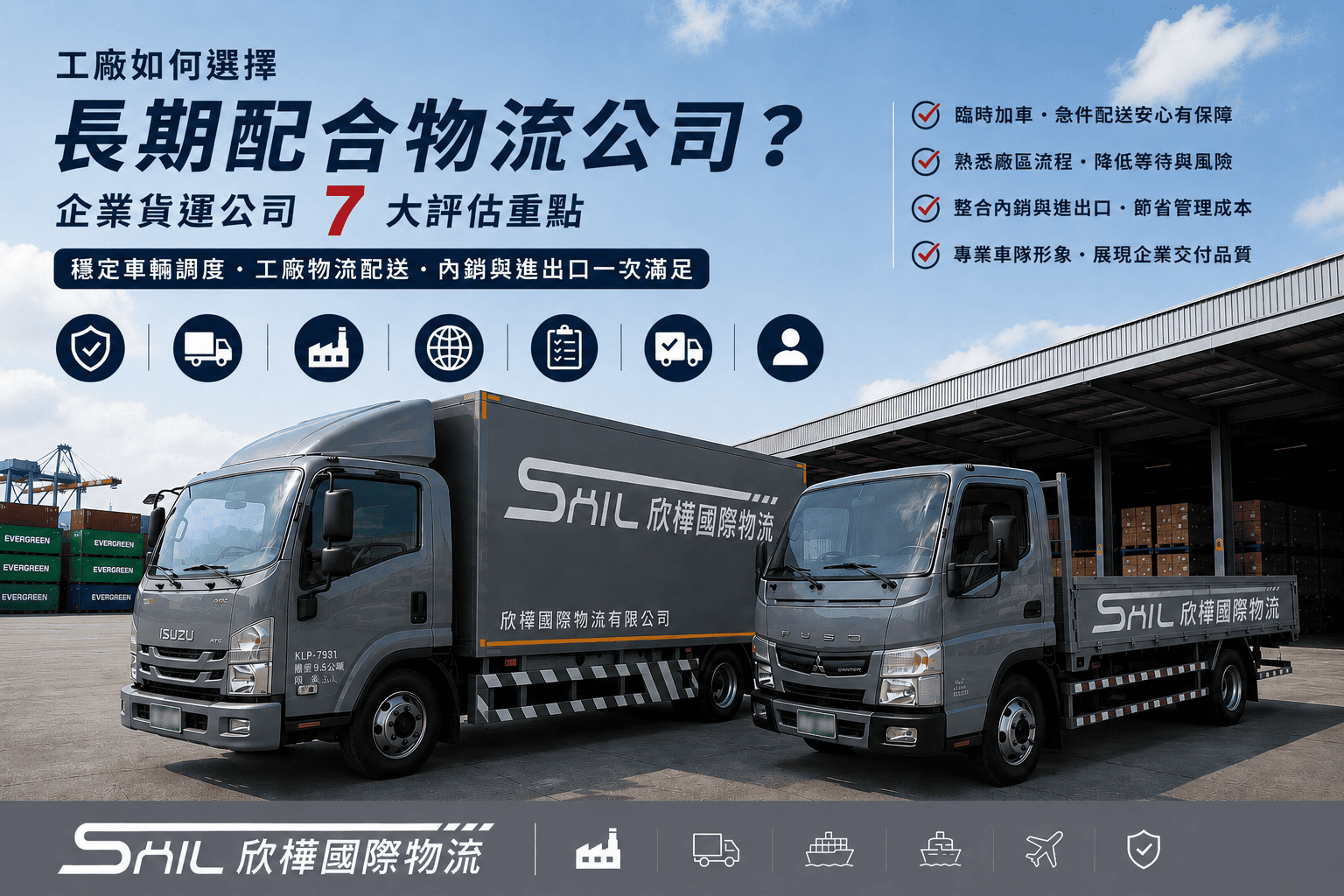
For manufacturers, technology companies, and factories, logistics is not an occasional need—it is part of daily operations. From inbound raw materials and component delivery to inter-factory transfers, finished goods distribution, port pickup, and airport cargo pickup, businesses need reliable transportation and fleet support. If a factory searches for a truck only when cargo is ready, it may need to request quotes and confirm vehicle types and delivery details every time. During urgent shipments, last-minute requests, or peak seasons, businesses may even face a common problem: the cargo is ready, but no truck is available.
For factories with frequent transportation needs, building a long-term relationship with a reliable B2B logistics company can make factory logistics more efficient and stable. A long-term logistics partner gradually becomes familiar with the company's cargo, regular routes, factory requirements, receiving procedures, and delivery schedules. So how should a factory choose the right logistics partner? Beyond freight rates, here are seven important factors to consider.
〈Related Reading: B2B Logistics vs. Parcel Delivery: Which Logistics Service Is Right for Your Business?〉
Why Do Factories Need a Long-Term Logistics Partner?
For individual shipments, price and delivery time may be the main considerations. Factory logistics is different. Transportation is often directly connected to purchasing, production, inventory, and customer delivery schedules. If a truck does not arrive on time, production or outbound shipments may also be delayed.
Factory transportation requirements can also change from day to day. A company may need a small truck for a few components today and a larger truck for a full load of raw materials tomorrow. When orders increase, customers request urgent delivery, or peak season arrives, additional vehicles may be needed at short notice.
One of the biggest advantages of working with a long-term logistics partner is that factories do not need to search for a new truck every time cargo needs to be shipped. A logistics company that already understands the customer's operations can help coordinate vehicles and transportation capacity for urgent shipments, additional truck requests, and peak-season demand, reducing the risk of having cargo ready with no available truck.
For factories, a stable logistics partnership is more than a convenience—it is part of maintaining a reliable supply chain.
1. Choose a Licensed and Professional B2B Logistics Company
When selecting a long-term B2B logistics company, the first consideration should not be price. Businesses should first confirm that the transportation provider is legally qualified to provide commercial freight services. When cargo is outsourced to a third-party carrier for a fee, the vehicles should be properly registered for commercial transportation.
This is especially important for factories that regularly outsource the transportation of raw materials, machinery, components, or finished goods. Legal operating qualifications should be treated as a basic requirement rather than choosing a carrier based only on the lowest freight rate.
What to check:
- Whether the company is legally qualified to provide commercial freight transportation
- Whether its trucks are registered for commercial use
- Whether it has an established fleet and driver management system
- Whether it has experience handling B2B and factory cargo
〈Related Reading: Commercial vs. Private Trucks in Taiwan: What Businesses Should Know〉
2. Evaluate Fleet Capacity and Truck Dispatch Capability
Factory cargo does not have the standardized dimensions of ordinary parcels. The number of pieces, weight, dimensions, and volume can vary significantly between shipments, which makes fleet capacity and vehicle dispatch capability important when selecting a logistics company.
A small shipment of electronic components may require a different vehicle from a full load of raw materials, while machinery and palletized cargo may have completely different loading requirements. If a logistics provider offers only limited vehicle options, it may not have enough flexibility when shipment volumes increase or transportation requirements change.
Instead of simply asking whether a truck is available, businesses should determine whether the logistics company can select and dispatch the appropriate vehicle based on cargo quantity, weight, dimensions, pickup location, destination, and required delivery time.
With a long-term partnership, the logistics provider can also become familiar with regular shipment volumes and delivery patterns, making it easier to coordinate additional capacity for urgent orders or peak-season demand.
3. Look for Experience in Factory Logistics and Delivery
Factory logistics involves much more than transporting cargo to an address. Factories, technology parks, industrial parks, and science parks may each have specific procedures for vehicle entry, security registration, unloading, contact persons, and receiving times.
If drivers are unfamiliar with these procedures, they may need to ask for directions, contact information, or entry instructions after arriving at the facility. This can increase waiting time and may affect unloading schedules or production planning.
With repeated deliveries, a long-term logistics provider and its drivers can gradually become familiar with:
- Regular pickup and delivery locations
- Factory entry requirements
- Shipping and receiving contacts
- Required delivery time slots
- Unloading locations and procedures
- Special requirements for different customers
This reduces repeated communication and minimizes operational errors. For semiconductor, electronics, precision equipment, and high-tech industries, experience is particularly important because cargo safety, delivery schedules, facility procedures, and transportation requirements are often more demanding.
〈Related Reading: High-Tech Industry Logistics: Key Requirements for Science Park and Industrial Park Deliveries〉
4. Can the Logistics Company Handle Both Domestic and Import/Export Transportation?
Manufacturing logistics rarely involves only one type of transportation. Raw materials may be imported from overseas and transported from a port or airport to the factory after customs clearance. Once production is complete, finished goods may need to be distributed to business customers throughout Taiwan or transported to a port or airport for export.
If your company requires both domestic distribution and import/export logistics, consider whether the logistics provider can handle:
- Port cargo pickup and delivery
- Airport cargo pickup and delivery
- Imported cargo delivery to factories
- Domestic distribution of finished goods
- Raw material and cargo transfers between factories
- Export cargo delivery to ports and airports
- Dedicated trucks and regular delivery routes
- Bonded cargo transportation
Using the same B2B logistics company for both domestic and import/export transportation can reduce the need to coordinate multiple carriers while creating a consistent logistics contact and delivery process.
〈Related Reading: Domestic Logistics in Taiwan: Distribution and Transportation Guide〉
〈Related Reading: Import and Export Logistics Process: From Customs Clearance to Final Delivery〉
5. Can Imported Cargo Be Delivered to the Factory Quickly After Customs Clearance?
For factories that import raw materials, components, or equipment, customs clearance is not the end of the logistics process. Once the cargo is released by customs, transportation still needs to be arranged from the port or airport to the factory, warehouse, or designated destination.
With a regular logistics partner, businesses can provide cargo details, estimated release times, and delivery requirements in advance. The logistics company can then plan the appropriate vehicle before the cargo becomes available, helping reduce delays caused by last-minute truck searches and communication between multiple parties.
For companies with frequent or high-volume imports, working directly with a regular logistics provider also makes it easier to track pickup schedules, vehicle dispatch, and delivery progress.
〈Related Reading: What Happens After Customs Clearance? Import Cargo Delivery to Factories Explained〉
If your company is still deciding between air freight and sea freight, consider cargo value, weight, volume, lead time, and transportation cost when choosing the appropriate shipping method.
〈Related Reading: Air Freight vs. Sea Freight: Which Is Better for Your Shipment?〉
6. Check Bonded Transportation Capabilities
If your business handles bonded cargo, operates within bonded facilities, science parks, export processing zones, or other customs-controlled areas, it is not enough to confirm that the logistics company has commercial trucks. You should also determine whether the provider is qualified to transport bonded cargo.
Commercial freight transportation and bonded transportation are not the same. Not every commercial freight company or truck is qualified to transport bonded cargo.
If your factory currently handles—or may handle—bonded cargo in the future, including bonded transportation capability in your logistics partner evaluation can prevent the need to find another carrier when such shipments arise.
〈Related Reading: What Is a Bonded Truck? A Guide to Bonded Cargo Transportation in Taiwan〉
7. Do Not Compare Freight Rates Alone—Consider Long-Term Reliability
Freight rates are important when selecting a logistics company, but choosing the cheapest truck for every shipment can overlook the hidden costs that affect factory operations.
These costs may include unavailable trucks for urgent shipments, drivers unfamiliar with factory procedures, incorrect vehicle selection, repeated communication, delivery delays, and the administrative time required to search for new carriers and request quotations for every shipment.
For a long-term logistics partnership, businesses should also evaluate:
- Reliability of regular truck dispatch
- Ability to handle urgent and additional truck requests
- Transportation capacity during peak seasons
- Response to unexpected delivery issues
- Availability of a dedicated point of contact
- Driver familiarity with factory and customer procedures
- Overall consistency of service quality
A reliable long-term logistics partner is not simply a company that can provide a truck on a normal day. It should also be willing to help coordinate solutions when customers face urgent shipments, additional vehicle requirements, or peak-season transportation demand.
For factories, this level of logistics support can be more valuable than saving a small amount on a single shipment.
〈Related Reading: How to Choose a Logistics Company in Taichung: 5 Key Factors for Businesses〉
Fleet Appearance Is Also Part of Professional Factory Delivery
When a factory outsources finished goods transportation, the logistics vehicle may deliver directly to the factory's customers—or even to its customers' customers. In these situations, the condition of the truck, driver professionalism, and delivery process can become part of the overall customer experience.
An old or poorly maintained truck with unclear identification may affect the recipient's impression of the delivery, even when the cargo itself arrives without any problems. In contrast, clean vehicles, consistent fleet branding, and clear company identification can create a more professional presentation when finished goods arrive at the customer's facility.
For companies that value brand image, supplier quality, and customer experience, logistics vehicles are not only transportation tools—they can also represent the final stage of the company's service delivery.
Factory Logistics Company Checklist
| Evaluation Factor | What Businesses Should Check |
|---|---|
| Legal Qualifications | Whether the provider is legally qualified for commercial freight transportation and uses properly registered vehicles |
| Fleet Capacity | Whether the company has a stable fleet and can dispatch different vehicle types |
| Factory Delivery Experience | Whether drivers understand factory entry, receiving, unloading, and proof-of-delivery procedures |
| Urgent Dispatch | Whether additional capacity can be coordinated for urgent shipments and peak seasons |
| Service Coverage | Whether the transportation network covers the company's major pickup and delivery locations |
| Import/Export Logistics | Whether the company can handle port pickup, airport pickup, and import/export cargo delivery |
| Bonded Transportation | Whether the provider has the required qualifications if bonded cargo transportation is needed |
| Fleet Image | Whether vehicles are clean, well maintained, and clearly branded |
| Long-Term Partnership | Whether the provider offers a consistent point of contact, understands your requirements, and provides reliable support |
Recommended B2B Logistics Company in Taiwan: SHIL International Logistics
If your factory is looking for a reliable long-term B2B logistics company in Taiwan, SHIL International Logistics serves manufacturers, technology companies, import/export businesses, and other B2B customers. Our services include factory logistics, domestic distribution, dedicated truck transportation, port and airport cargo pickup and delivery, and bonded cargo transportation.
SHIL is a licensed commercial freight transportation company with its own fleet. We evaluate the appropriate vehicle and delivery method based on cargo quantity, weight, dimensions, pickup and delivery locations, and required schedules. Our primary service area covers Taichung and central Taiwan, with transportation available to Hsinchu, Taoyuan, Taipei, New Taipei, and other areas based on customer requirements.
For SHIL, a long-term partnership means more than simply accepting orders and dispatching trucks. It means gradually understanding each customer's regular routes, cargo requirements, factory procedures, and receiving needs. When customers need additional trucks, urgent deliveries, or extra transportation capacity during peak seasons, we work to coordinate available vehicles and help keep shipments moving.
SHIL also places importance on fleet appearance and daily vehicle maintenance. Our trucks feature consistent corporate gray branding, SHIL logos, and clean, well-maintained cargo bodies. When customers entrust us with finished goods deliveries, our goal is not only to transport cargo safely but also to provide a professional final delivery experience at the customer's destination.
For factories with regular transportation needs, the most important factor is not finding the cheapest truck for every shipment. It is having a reliable logistics partner you can contact when transportation is needed, who can help respond to urgent situations and understands your business over the long term.
Factory Logistics FAQ
Does a factory need to use a professional freight company?
If a factory uses its own vehicles to transport its own goods, transportation can be arranged internally. When outsourcing cargo transportation to a third-party carrier, however, businesses should choose a properly licensed commercial freight company and confirm that its fleet and delivery capabilities meet their requirements.
Why should factories work with a long-term logistics partner?
A regular logistics provider gradually becomes familiar with the factory's cargo, routes, facility procedures, and receiving requirements. This reduces the time spent searching for trucks and explaining delivery information for every shipment. It also provides an established contact when urgent shipments, additional vehicles, or peak-season capacity are needed.
Can a B2B logistics company provide daily truck service?
Yes. Depending on the factory's requirements and the logistics provider's available capacity, companies can arrange daily, weekly, or scheduled transportation services, including regular routes and dedicated truck delivery.
What if a factory suddenly needs an additional truck?
If the factory already has a long-term logistics partner, it can contact its regular logistics representative to coordinate additional transportation based on cargo requirements. Immediate availability still depends on fleet capacity, but an established relationship reduces the need to search for an unfamiliar carrier at the last minute.
Can a B2B logistics company handle both import/export and domestic delivery?
Yes, depending on the provider's capabilities. Factories with both international and domestic transportation needs should consider logistics companies that can handle port and airport cargo pickup, factory delivery, domestic distribution, and bonded transportation.
Is a long-term logistics partner always cheaper?
Not necessarily. The value of a long-term logistics partnership is not limited to the freight rate for a single shipment. Reliable dispatch, a consistent point of contact, familiarity with factory procedures, and the ability to respond to urgent requirements can reduce the overall time and operational costs involved in factory logistics.
Conclusion
Choosing a long-term logistics company for your factory should involve more than comparing freight rates. Legal qualifications, fleet capacity, factory delivery experience, service coverage, import/export logistics, bonded transportation, and the ability to support urgent or peak-season shipments can all affect the quality of a long-term partnership.
For manufacturers and technology companies with frequent transportation requirements, a reliable B2B logistics company is more than a truck provider. It becomes familiar with your cargo, routes, factory procedures, and delivery requirements while providing consistent support for both routine and urgent shipments. When your logistics partner truly understands your operations, transportation becomes more than a one-time service—it becomes a reliable part of your supply chain.
Article classification
Latest articles
- How to Choose a Long-Term Logistics Partner for Your Factory? 7 Key Factors for B2B Logistics
- B2B Logistics Company vs. Parcel Delivery: What’s the Difference?
- What’s the Difference Between Green and White License Plate Trucks?
- What Makes High-Tech Logistics Different? Science Park & Industrial Park Delivery Explained