
BLOG

What’s the Difference Between Green and White License Plate Trucks?
Jun 26, 2026
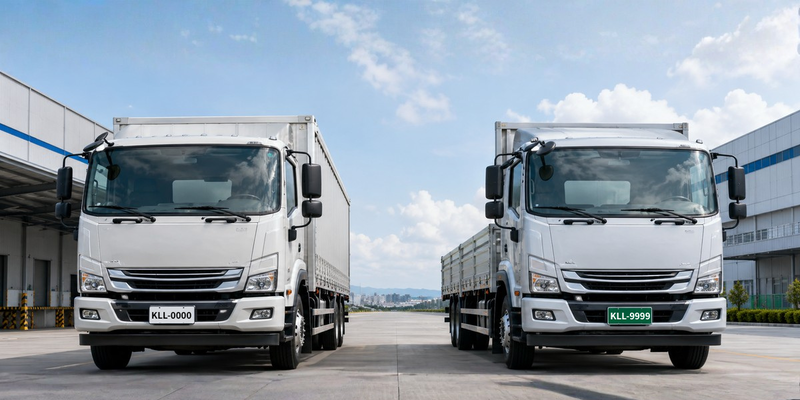
When choosing a logistics company, businesses often compare freight rates, truck types, and delivery times. However, there is one important detail they should confirm first: Is the vehicle actually transporting the goods a green license plate truck or a white license plate truck? Both types of trucks can carry goods, but they serve different purposes. Simply put, green license plate trucks can legally transport goods for others and charge freight fees, while white license plate trucks are primarily used to transport the owner’s own goods.
If a business hires a vehicle that is not licensed for commercial transportation, inspections, traffic accidents, or cargo damage may make liability determination and insurance claims more complicated.
What Is a Green License Plate Truck?
A green license plate truck is a commercial truck with a green license plate and white lettering. In Taiwan, it is also commonly referred to as a commercial freight truck. These vehicles are typically registered under licensed trucking companies and may legally accept transportation assignments from businesses or individuals, carry goods belonging to others, and charge freight fees. However, “commercial freight truck” is a commonly used term. Whether a vehicle can legally provide commercial transportation services should ultimately be determined by its registered use, vehicle registration documents, and whether the operator holds the required motor carrier license.
Common freight transportation services include:
- Import and export cargo delivery
- Transportation of factory materials and finished products
- Palletized and oversized cargo transportation
- Machinery and equipment transportation
- Cargo pickup and delivery at warehouses, seaports, or airports
What Is a White License Plate Truck?
A white license plate truck generally refers to a private-use truck primarily used to transport goods owned by the vehicle owner, company, or business. For example, a factory may use its company truck to deliver its own products, a retailer may transport its own inventory, or an engineering company may carry its own construction equipment. These situations are generally considered private transportation. Therefore, a white license plate truck is not prohibited from carrying goods; in principle, it simply cannot transport goods for others as a commercial service and charge freight fees.
If a private-use truck regularly delivers goods for other companies in exchange for payment, it may constitute the unauthorized operation of a trucking business and may result in penalties. Describing the payment as fuel expenses, service fees, or handling charges does not necessarily change the fact that the service is paid freight transportation.
What Is the Difference Between Green and White License Plate Trucks?
When hiring a truck, businesses should not judge its legal status solely by whether the company name is printed on the vehicle or whether the driver wears a uniform. The most direct method is to check the license plate color and the vehicle’s registered use stated on its registration documents. The following table summarizes the key differences businesses should understand when choosing a logistics company.
| Comparison Item | Green License Plate Truck (Commercial Truck) | White License Plate Truck (Private Truck) |
|---|---|---|
| License Plate Appearance | Green background with white lettering | White background with black lettering |
| Primary Use | Commercial freight transportation, logistics delivery, and trucking services | Transporting goods owned by the company or individual |
| Suitable for Paid Transportation Services | Yes, it is registered for commercial freight transportation | No, it cannot generally be used for commercial freight services |
| Common Users | Logistics companies, trucking companies, and commercial motor carriers | Factories, retailers, self-employed businesses, or company-owned fleets |
| Suitability for Business-Commissioned Delivery | Suitable for third-party logistics and business cargo delivery | Primarily suitable for private transportation, not for providing external logistics services |
| Key Management Considerations | Operating licenses, fleet management, driver dispatch, and transportation protection | Company-owned vehicle management and internal business use |
From the perspective of corporate procurement or logistics managers, choosing a green license plate truck is not merely a formality—it is about reducing transportation risks. When cargo is delivered by a licensed trucking company, businesses can more easily verify the vehicle’s registered use, service coverage, delivery responsibilities, and subsequent management procedures. If a business overlooks the vehicle’s qualifications solely because the price is lower, it may discover after an accident that liability and insurance coverage are far more complicated than expected.
Why Should Businesses Choose Green License Plate Trucks?
When a business hires a logistics company to transport its goods, it is effectively entrusting cargo safety, delivery deadlines, and customer commitments to an external partner. If the vehicle is not registered for commercial use, it may increase uncertainty regarding legal compliance, insurance, and operational management. Businesses should therefore treat the use of green license plate trucks as one of the basic checks when choosing a logistics company.
1. Ensure Legal Compliance in Freight Transportation
Green license plate trucks are registered for commercial use and may legally accept transportation assignments and charge freight fees. For businesses that require on-time delivery, using legally registered vehicles can reduce the risk of roadside inspections, transportation interruptions, or delivery delays. This is particularly important for import and export cargo, factory materials, and regularly scheduled B2B freight transportation.
2. Make Liability for Accidents and Cargo Damage Easier to Determine
During transportation, cargo may be affected by collisions, tipping, rain exposure, or damaged packaging. Licensed logistics companies generally maintain dispatch records, proof of delivery, and incident reports, making problems easier to trace. If a vehicle’s actual use is inconsistent with its registration or insurance coverage, determining liability and processing insurance claims may become more complicated after an accident. Whether compensation is available will still depend on the insurance policy terms and the circumstances of the incident.
3. Support Corporate Audits and Supply Chain Management
Many manufacturers, publicly listed companies, and multinational corporations require logistics suppliers to provide company registration documents, vehicle information, or proof of insurance. Using legally registered green license plate trucks not only ensures regulatory compliance but also reduces risks during supplier evaluations and corporate audits.
4. Benefit from More Comprehensive Fleet and Driver Management
Licensed trucking companies generally establish more comprehensive fleet management systems, including vehicle maintenance, driver assignments, route dispatching, delivery schedule management, and incident reporting. For B2B companies, these management capabilities directly affect delivery reliability. Even if a logistics company offers lower rates for individual deliveries, inadequate fleet management may lead to delays, unstable dispatching, and higher communication costs, ultimately reducing overall supply chain efficiency.
5. Better Support Long-Term Business Logistics Needs
Business logistics requirements are rarely one-time needs. They are usually long-term, continuous, and likely to change as the business grows. For example, a company may require ordinary factory deliveries today, port cargo pickup tomorrow, and bonded cargo transportation, science park delivery, or dedicated trucking services between northern, central, and southern Taiwan in the future. A licensed trucking company with a complete fleet and strong dispatch capabilities is better positioned to support long-term partnerships and expanding logistics requirements.
Can White License Plate Trucks Transport Goods for Others?
This is one of the most commonly misunderstood questions among businesses and individuals. White license plate trucks are primarily intended for private transportation, meaning they carry goods belonging to the vehicle owner or company. If a company uses its own truck to move its products, materials, or equipment from one location to another, there is generally no issue. However, transporting goods for other businesses in exchange for payment constitutes commercial transportation and should be handled by properly licensed vehicles and operators in accordance with applicable regulations.
Therefore, when hiring a third-party delivery provider, businesses should not simply ask whether a truck is available. They should ask whether the provider is a licensed trucking company, whether the vehicle is legally registered for commercial transportation, and whether suitable management procedures and transportation protection are in place. These questions are more important than simply comparing which company offers the lowest price.
Reminder: A white license plate truck is not inherently illegal. The key issue is whether it is being used for its registered purpose. Using a private truck to transport a company’s own goods is different from a logistics company carrying goods for external customers. When hiring an external logistics company, businesses should first confirm that the provider holds the required commercial freight transportation qualifications.
What Is the Difference Between a Green License Plate Truck and a Bonded Truck?
Green license plate trucks and bonded trucks are often confused, but they represent different qualifications. A green license plate indicates that a truck is registered for commercial freight transportation. A bonded truck, on the other hand, is a vehicle approved through the relevant procedures to legally transport bonded cargo. In other words, a green license plate is one of the basic qualifications for commercial trucking, while bonded truck authorization is an additional qualification for specific bonded cargo transportation requirements.
Not every green license plate truck is authorized to transport bonded cargo. If a company’s goods involve bonded areas, export processing zones, free trade zones, science parks, or other bonded operations, it must confirm whether the logistics company is qualified to provide bonded transportation services. This is especially important for import and export businesses because improperly arranged bonded cargo transportation may affect customs clearance, cargo pickup, and subsequent delivery procedures.
〈Further Reading: What Is a Bonded Truck? Key Facts About Bonded Cargo Transportation〉
What Else Should Businesses Consider Besides License Plate Color When Choosing a Logistics Company?
Confirming that a logistics company uses green license plate trucks is an important starting point for identifying a licensed commercial trucking company, but it is not the only criterion. A suitable logistics partner must also provide reliable delivery services, strong fleet dispatch capabilities, relevant industry experience, and effective incident management. The following are key factors businesses should evaluate when choosing a logistics company.
| Evaluation Item | What Businesses Should Verify |
|---|---|
| Legal Operating Qualifications | Whether the provider is a licensed trucking company and uses green license plate trucks for commercial freight transportation. |
| Fleet and Dispatch Capabilities | Whether the company has a dedicated fleet, a driver management system, and the ability to handle urgent transportation requests. |
| Delivery Service Coverage | Whether the company can provide delivery services in central and northern Taiwan, island-wide transportation, or dedicated truck services. |
| Import and Export Logistics Capabilities | Whether the company is familiar with seaport cargo pickup, airport cargo pickup, post-customs-clearance delivery, and factory receiving procedures. |
| Specialized Cargo Capabilities | Whether the company can handle bonded cargo, precision equipment, high-tech industry shipments, or science park deliveries. |
If a business considers price alone, it may save a small amount on freight costs in the short term. However, unreliable delivery, high communication costs, and poor incident management may negatively affect overall operations in the long term. For businesses requiring a regular logistics partner, choosing a logistics company with legal qualifications and comprehensive service capabilities is often more important than selecting the lowest-priced provider.
〈Further Reading: How to Choose a Logistics Company in Taichung: Five Key Factors for Businesses〉
Which Businesses Should Pay Particular Attention to Green License Plate Trucks and Legal Trucking Qualifications?
Large corporations are not the only businesses that need to verify whether a logistics company operates legally. Any business that hires a third-party logistics company to deliver goods—especially for long-term partnerships, regular deliveries, high-value cargo, or import and export shipments—should verify the provider’s operating qualifications. Manufacturers, electronics companies, semiconductor supply chain businesses, machinery and equipment suppliers, trading companies, and businesses with significant warehousing and logistics requirements should treat vehicle qualifications and logistics management as basic evaluation criteria.
For example, if raw materials do not arrive at a manufacturing plant on time, production schedules may be disrupted. If high-value components belonging to a technology company are damaged during transportation, the resulting losses may be substantial. If an import or export company experiences delays in collecting cargo after customs clearance, it may incur additional storage costs or miss customer delivery deadlines. These situations demonstrate that a logistics company’s legal commercial freight qualifications are not a minor detail—they are an essential part of supply chain risk management.
Green License Plate Truck FAQ
Can a Green License Plate Truck Transport the Company’s Own Goods?
Yes. Green license plate trucks are registered for commercial freight transportation. In addition to providing commercial trucking services, they may also transport goods owned by the company. Actual transportation arrangements should still comply with the vehicle’s registered use, company management policies, and applicable regulations.
Can a White License Plate Truck Transport Goods for Others?
White license plate trucks are primarily intended for private transportation, meaning they carry goods belonging to the vehicle owner or company. If transportation involves carrying goods for others in exchange for payment, the vehicle is generally unsuitable for use as an ordinary commercial freight truck. Businesses hiring delivery services should confirm that the provider holds the required commercial freight transportation qualifications.
How Can You Quickly Identify a Green License Plate Truck?
The most straightforward method is to check the color of the license plate. Green license plate trucks have a green background with white lettering, while white license plate trucks have a white background with black lettering. However, businesses should not consider license plate color alone when choosing a logistics company. They should also verify whether the provider has a reliable fleet, relevant service experience, and comprehensive delivery management capabilities.
Is a Bonded Truck the Same as a Green License Plate Truck?
No. A green license plate indicates that a truck is registered for commercial freight transportation, while bonded truck status represents a special qualification to transport bonded cargo. Not every green license plate truck is authorized to carry bonded goods. If a business requires bonded logistics services, it should separately confirm whether the logistics company holds the appropriate bonded transportation qualifications.
Do All Logistics Companies Use Green License Plate Trucks?
Legally operated trucking companies generally use green license plate trucks to provide commercial freight transportation services. However, different transportation arrangements may still exist in the market. Before hiring a delivery provider, businesses should proactively confirm whether the company is a legally licensed commercial motor carrier.
Is Checking for Green License Plate Trucks Enough When Choosing a Logistics Company?
No. A green license plate is a basic requirement, but businesses should also evaluate the logistics company’s fleet size, dispatch capabilities, delivery coverage, import and export logistics experience, bonded transportation qualifications, and industry experience. These capabilities are what truly determine the quality of a long-term logistics partnership.
Conclusion
The primary difference between green and white license plate trucks is not merely the color of the plate, but the vehicle’s registered use and commercial operating qualifications. For businesses, choosing a licensed trucking company that uses green license plate trucks can reduce transportation risks and make cargo delivery, liability, and subsequent management procedures clearer. This is especially important for manufacturers, technology companies, and import and export businesses, where logistics operations directly affect production schedules and customer delivery deadlines. Legal qualifications and fleet management should therefore be treated as fundamental criteria when choosing a logistics company.
SHIL International Logistics specializes in B2B logistics, import and export cargo delivery, inland transportation, and bonded transportation services. Our primary service coverage includes central and northern Taiwan, and we arrange suitable vehicles and delivery plans according to each business’s transportation requirements. When choosing a logistics partner, businesses should look beyond price and confirm whether the company has legal commercial freight qualifications, a reliable fleet, and comprehensive logistics capabilities—helping make every shipment safer, more reliable, and more efficient.

Article classification
Latest articles
- How to Choose a Long-Term Logistics Partner for Your Factory? 7 Key Factors for B2B Logistics
- B2B Logistics Company vs. Parcel Delivery: What’s the Difference?
- What’s the Difference Between Green and White License Plate Trucks?
- What Makes High-Tech Logistics Different? Science Park & Industrial Park Delivery Explained